
Category: Compliance & Risk Management | Read Time: 12 minutes
Executive Summary
Here’s something that keeps CFOs up at night: most enterprises have absolutely no idea how much financial and legal risk they’re actually sitting on when it comes to IT asset disposition. We’re talking about hidden compliance costs, potential regulatory fines, environmental liability, shareholder scrutiny—the whole nightmare scenario. And here’s the thing: it’s all completely avoidable.
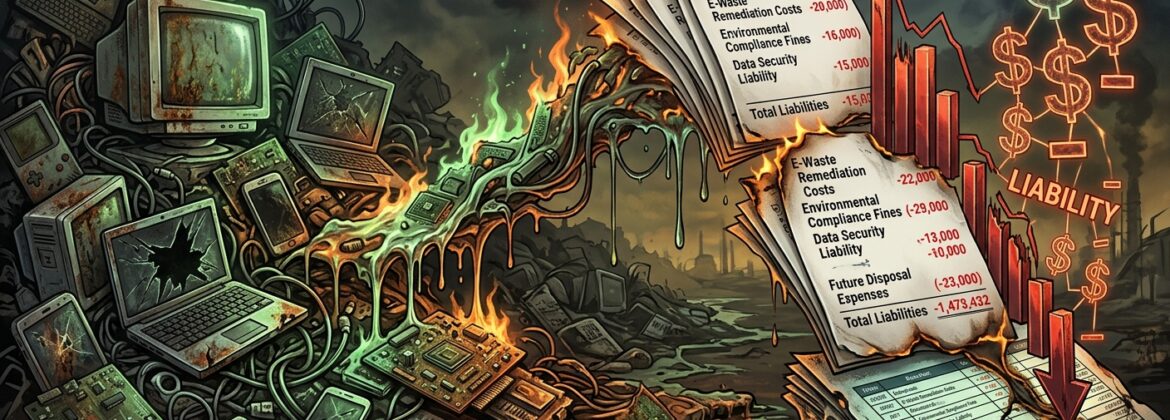
When you retire IT equipment, your finance team treats it like a simple disposal cost. But that’s like looking at a single data point and thinking you understand the whole picture. Electronic waste creates cascading liabilities across compliance, environmental, data security, and reputational domains—and each one can cost you anywhere from thousands to millions of dollars.
This article walks you through the quantifiable financial and legal risks of inadequate ITAD practices, and then shows you why R2v3-certified recycling isn’t a compliance checkbox—it’s essential risk mitigation that pays for itself many times over.
The Financial Exposure: What Companies Don’t Know
Let’s start with a number that should make you uncomfortable: 62% of enterprises lack documented ITAD procedures. That means the majority of companies don’t actually know what’s happening to their retired IT equipment. If that’s your situation, you’re exposed to multiple sources of liability right now.
Regulatory Fines and Penalties
The regulatory environment for e-waste has gotten teeth. Serious teeth. The EPA can assess penalties up to $32,500 per day per violation for improper waste handling. A single data center decommissioning handled wrong? That’s easily a six-figure fine before you even breathe. And that’s just the federal level.
State regulators don’t mess around either. California’s electronic waste recycling law (CalRecycle) has generated over $2.1 million in civil penalties since 2010. New York, Massachusetts, and Connecticut have similar enforcement records. The CSRD (Corporate Sustainability Reporting Directive) now mandates transparent environmental accounting—report inaccurate ITAD practices and you’re looking at investor lawsuits and regulatory investigation.
And then there’s the Basel Convention issue. Ship e-waste internationally without proper documentation? That’s federal prosecution territory. We’re talking import/export penalties that can dwarf the original disposal cost.
Data Breach Liability and Negligent Disposal
This is the hidden time bomb in most ITAD operations, and honestly, it keeps us up at night too.
When a hard drive or storage device isn’t properly sanitized according to NIST 800-88 standards, sensitive company and customer data becomes vulnerable. And we’re not talking about a theoretical risk here—this is happening right now, in real companies.
The IBM Data Breach Report pegs the average cost of a customer PII breach at $4.29 million. That’s just the direct cost. Add GDPR fines (up to €20M or 4% of revenue), shareholder litigation, and reputational damage, and you’re looking at an enterprise-threatening event.
We’ve seen cases where proprietary source code was recovered from recycled equipment. Competitive advantage gone. We’ve seen healthcare organizations face HIPAA violations ($750K+ penalties) because patient data was recoverable from retired medical device hardware. These aren’t hypotheticals.
Environmental Liability and Remediation Costs
E-waste contamination is a long-tail liability. When hazardous materials (lead, mercury, cadmium, arsenic) get into soil and groundwater, companies can be held liable for remediation decades later. Superfund site status can trigger cleanup costs of $10-50M or more. Brownfield remediation typically runs $500K to $2M per site.
And here’s what really matters to the C-suite: lenders and investors now conduct environmental due diligence. A company with documented e-waste liabilities faces higher borrowing costs or lending restrictions. That’s a direct hit to your balance sheet.
Quantifying Your Risk: The Math
Let’s build a realistic scenario. Mid-sized enterprise (500 employees) refreshing IT annually:
• 150 servers, 300 PCs, 200 printers, storage arrays
• ~500TB of potentially sensitive information
• Operations across 6+ states and the EU (GDPR + CSRD exposure)
Here’s your liability exposure:
• Single data breach: $4.29M
• EPA violation fines: $100K-$500K
• CSRD non-compliance penalties + shareholder litigation: $1-5M
• Environmental remediation (if site contamination): $500K-$2M
Total Potential Exposure: $6-12M
Now compare that to the cost of R2v3-certified ITAD: 2-4% of recovered asset value. Usually runs $50-100K annually for a company your size.
The ROI math is brutal in your favor. A 60x to 120x return on investment. This isn’t just compliance—this is insurance.
Why R2v3 Certification Eliminates This Risk
R2v3 certification is the global standard for responsible electronics recycling. And it’s not self-certification—we’re talking about independent auditing and ongoing compliance verification. This matters because it creates a legal shield for your company.
When regulators come knocking—and they do—you have documented proof that your ITAD partner meets strict standards. When shareholder activists question your environmental practices, you have third-party certification. When your insurance company evaluates your risk profile, they see certified ITAD as meaningful risk mitigation.
Here’s what R2v3 actually protects:
Data Security: Certified facilities must document data destruction using NIST 800-88 certified methods. Your company can prove to regulators and investors that sensitive data was irrecoverably destroyed. No ambiguity. No liability.
Environmental Compliance: Certified facilities track hazardous materials through proper channels. No illegal dumping. No groundwater contamination liability. Your company has documented evidence of compliance.
Chain of Custody: R2v3 requires detailed tracking of where every asset ends up. When something goes wrong downstream, you have documentation proving you did your due diligence. That’s your liability shield.
Worker Safety & Labor Compliance: Certified facilities meet strict safety standards. Your company cannot be implicated in labor violations because independent auditors have verified compliance.
Insurance & Audit Defense: When faced with regulatory investigation, documented R2v3 certification provides defense. Your insurance company recognizes certified ITAD as serious risk mitigation. That can mean lower premiums.
The Bottom Line
The financial case for R2v3-certified ITAD is overwhelming. We’re not talking about compliance theater here—we’re talking about protecting your company from real, quantifiable financial exposure.
A single incident—one data breach, one regulatory fine, one environmental liability—can cost millions. The certified ITAD service that prevents that incident costs thousands. That’s not a difficult business decision.
Chicago Surplus Computers (CSC) provides R2v3-certified ITAD with complete compliance documentation. Our processes protect your data, your environment, and your bottom line. More importantly, they protect you from the financial and legal exposure that keeps enterprises up at night.
The question isn’t whether you can afford certified ITAD. The question is whether you can afford not to have it.
Learn more at https://chicagosurpluscomputers.com/itad-calculator/
Follow CSC on LinkedIn: https://www.linkedin.com/company/chicagosurpluscomputers/

Leave a Comment