
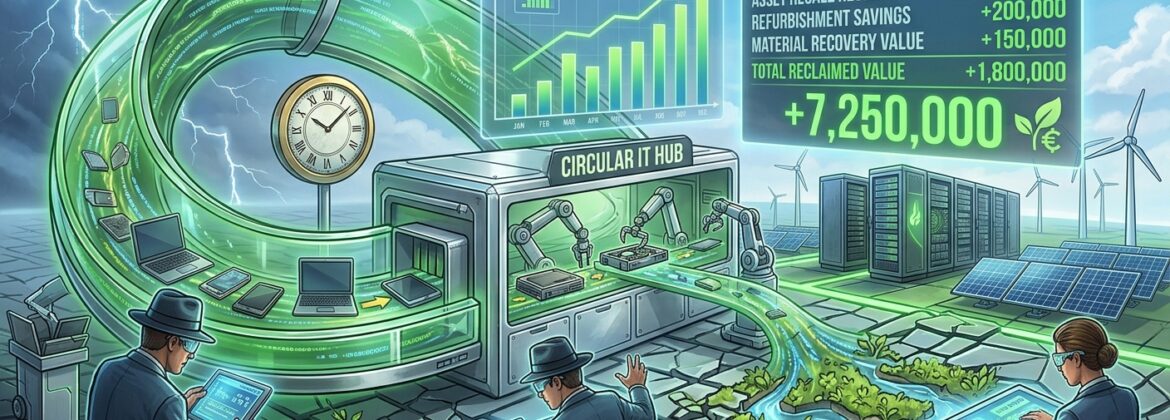
The Circular Economy Opportunity: Why Your Used IT Assets Are Revenue, Not Waste
Category: Business Strategy | Read Time: 10 minutes
Executive Summary
The circular economy in IT is booming. Secondary markets for refurbished hardware, remanufactured components, and materials recovery are generating billions annually. But most enterprises treat IT retirement as a cost center rather than a revenue opportunity. Here’s how to flip that mindset.
The Secondary Market Reality
Refurbished IT equipment is no longer a budget brand for cost-conscious buyers. Global enterprises, schools, nonprofits, and governments actively purchase refurbished servers, storage arrays, and networking equipment—often with the same performance and reliability as new, but at 40-60% discount.
The refurbished IT market exceeded $12 billion globally in 2025 and is growing 15% annually. Your retired equipment is someone else’s strategic asset.
Why Refurbishment Matters
When your company retires a 3-year-old server, it’s often fully functional. Refurbished by certified providers, it can deliver another 5-7 years of productive life. This has profound implications:
Extends device lifecycles, reducing e-waste and environmental impact
Makes enterprise-grade IT accessible to budget-constrained organizations
Reduces manufacturing demand for new equipment
Creates circular revenue streams for your organization
Improves data security through certified asset management
From a business standpoint: the device you’re retiring has residual value. Proper ITAD providers can monetize that value while ensuring data security and environmental compliance.
Materials Recovery & Commodity Markets
Beyond refurbishment, materials recovery from e-waste is a genuine commodity market. Precious metals (gold, silver, palladium), rare earth elements, copper, and aluminum recovered from electronics have real market value.
A single server can contain:
Grams of gold and silver in circuit boards
0.5+ lbs of copper in wiring
Several pounds of aluminum in chassis and heat sinks
Pounds of steel components
Recovered components for refurbishment and resale
When managed through certified recyclers like Chicago Surplus Computers (CSC), these materials command market prices. Your “waste” becomes recovered commodity value.
The Financial Model
Here’s the business case: a mid-size enterprise retiring 150 servers annually might realize:
Direct revenue from refurbishment: $15-30K (servers with residual value)
Commodity material recovery: $5-10K (precious metals, copper, etc.)
Tax incentives for certified donation: $2-5K
Cost avoidance from landfill fees: $5-10K
Total value realization: $27-55K annually from what was previously treated as disposal cost
Scale that across a global enterprise, and the secondary market opportunity becomes material.
Circular Economy & Corporate Strategy
Smart enterprises—and CSC is leading the way—are integrating ITAD and circular economy principles into their procurement strategy. They’re negotiating take-back agreements with vendors. They’re extending device lifecycles through refurbishment. They’re capturing secondary market revenue.
It’s not just sustainability—it’s financial optimization through circular thinking.

Leave a Comment