
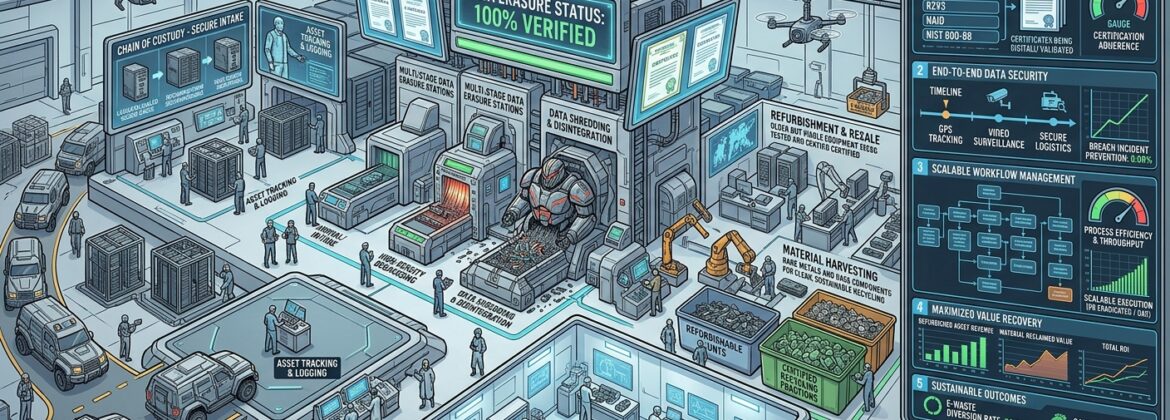
Strategic Data Center Decommissioning: Managing Risk in Large-Scale ITAD
Category: Operations & Risk Management | Read Time: 11 minutes
Executive Summary
Large enterprises are consolidating data centers. Cloud migration is accelerating. When you’re decommissioning a data center housing thousands of assets, complexity multiplies exponentially. Strategic ITAD planning becomes critical—and that’s where providers like CSC excel.
The Data Center Decommissioning Challenge
A mid-size data center decommissioning might involve:
500+ servers with sensitive production data
200+ storage arrays containing years of business records
1000+ GB of storage media requiring certified destruction
50+ network devices with configuration data
Licensing documentation and asset tracking requirements
Coordination across multiple business units and geographies
Mismanage this process, and you’re looking at data breaches, regulatory violations, environmental liability, and operational disruption. Strategic planning eliminates risk.
Phase 1: Planning & Inventory
Before touching a single device, you need comprehensive planning:
Complete asset inventory with data sensitivity classification
Identify devices with licensing restrictions (restricted export, etc.)
Document data residency and compliance requirements
Determine refurbishment candidates vs. disposal candidates
Establish data destruction timeline and sequence
Identify ITAD vendor and establish SLA
Develop communication plan for stakeholders
This phase typically takes 4-6 weeks for larger decommissionings.
Phase 2: Data Sanitization & Destruction
This is where most enterprises stumble. Data destruction must comply with NIST 800-88 standards and be certified and documented:
Cryptographic erasure for modern storage systems
Physical destruction for devices where data recovery risk is unacceptable
Certificate of destruction for every device
Chain of custody documentation throughout the process
Independent verification of destruction protocols
Archived documentation for regulatory defense
A single overlooked storage device can become your organization’s worst data breach.
Phase 3: Asset Logistics & Recovery
After data destruction, devices move through logistics:
Segregation of refurbishment candidates from recycling candidates
Transportation to certified facilities with tracking
Refurbishment of salvageable equipment
Materials recovery and commodity processing
Documented reporting on asset disposition and recovery value
Coordinate this through R2v3-certified vendors like Chicago Surplus Computers (CSC) who provide end-to-end visibility.
Phase 4: Reporting & Compliance
Document everything for regulatory and stakeholder communication:
Asset disposition reports for finance and audit
Environmental impact reporting for ESG disclosures
Data destruction certifications for compliance files
Cost recovery and revenue realization reporting
Vendor performance and audit results
This documentation protects you if regulators come calling later.
The Financial Case for Strategic ITAD
A properly managed data center decommissioning generates value:
Refurbished equipment sales: $50-150K (depending on equipment)
Material recovery and commodity revenue: $15-30K
Avoided landfill disposal costs: $5-10K
Tax incentives for certified donations: $5-15K
Total value realization: $75-205K from a single facility decommissioning
Compare this against the cost of a single data breach (millions), and strategic ITAD planning is obvious.

Leave a Comment