ITAD Market Trends 2026: How Chicago Surplus Computers is Leading Environmental Responsibility
Introduction: The Critical Intersection of Technology and Environment
The IT Asset Disposition (ITAD) industry is experiencing unprecedented growth in 2026. As businesses worldwide accelerate their digital transformation and data center modernization, the volume of electronic waste—e-waste—continues to reach critical levels. This comprehensive article explores the current ITAD market landscape, the environmental crisis at stake, and how responsible recyclers like Chicago Surplus Computers (CSC) are making a tangible difference in protecting our planet.
The Bottom Line: The global ITAD market is expanding rapidly, but so is the environmental responsibility required to manage it properly. Companies partnering with R2v3-certified recyclers aren’t just disposing of assets—they’re investing in a sustainable future.
The ITAD Market Explosion: By The Numbers
The ITAD industry is at an inflection point. Market forecasts reveal explosive growth driven by accelerating technology refresh cycles, regulatory pressure, and corporate sustainability mandates.
| Market Metric | Current Value (2026) | Projected Value | Growth Rate |
|---|---|---|---|
| Global ITAD Market Size | $18.6 – $31.9 Billion | $40.1 – $65.7 Billion (2033-2035) | 8.9% – 11.9% CAGR |
| Electronics Recycling Market | $65.8 Billion | Growing at 12.7% annually | Largest in Europe |
| Global E-Waste Volume | ~57 Million metric tons (2021) | 74 Million metric tons (2030) | Accelerating annually |
| Large Enterprise ITAD Demand | 62.9% of ITAD market share | Growing as ESG becomes mandatory | Executive-level priority |
Seven Defining ITAD Trends Shaping 2026
1. AI Adoption is Compressing Data Center Refresh Cycles
Enterprises are deploying AI infrastructure faster than traditional hardware lifecycles allow. This acceleration is pulling forward the obsolescence of servers, accelerators, and storage equipment—creating both urgency and opportunity for ITAD providers like CSC.
2. Reuse-First Strategies Gain Regulatory Tailwinds
Governments and regulatory bodies are increasingly favoring circular economy models. The EPA has intensified its focus on reducing e-waste through new 2026 guidelines that encourage reuse before recycling, aligning perfectly with CSC’s operational approach.
3. ESG Reporting Becomes Non-Negotiable
Environmental, Social, and Governance (ESG) reporting is no longer optional. Corporate sustainability disclosure requirements (CSRD) now demand comprehensive ITAD strategies. Companies must prove they’re managing Scope 3 emissions through certified, transparent disposal processes.
4. Data Security by Design and Zero-Trust Programs
With approximately 65% of enterprises demanding secure data destruction services, data security has become the cornerstone of ITAD operations. NIST 800-88 compliance and irrecoverable data sanitization are table-stakes requirements.
5. Battery Circularity Accelerates Alongside Data Center Growth
As data center expansion continues, battery recycling and recovery of lithium, cobalt, and nickel has become a specialized, high-value segment. Proper battery disposition is critical to environmental safety and resource recovery.
6. Media Sanitization Standards Continue to Tighten
Regulatory requirements for data erasure and media destruction are becoming more stringent globally. Certified ITAD providers must maintain updated protocols and documentation.
7. Net Zero Commitments Push Carbon-Accountable ITAD
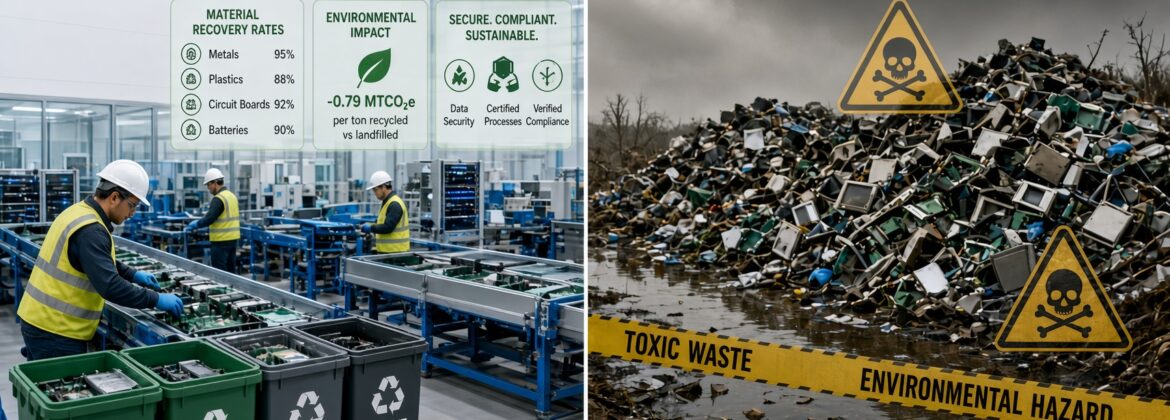
Companies with net-zero commitments are now quantifying the carbon impact of their IT asset disposition practices. According to EPA WARM data, recycling mixed electronics generates -0.79 metric tons of CO₂-equivalent per short ton recycled versus landfilling.
The E-Waste Crisis: Why Scale and Speed Matter
The Hard Truth: In 2022, the world generated 62 million metric tonnes of e-waste. Less than a quarter was recycled appropriately. The remaining 75% presents an environmental and public health catastrophe.
The Hidden Cost of Improper Disposal
Electronic devices contain hazardous substances including lead, mercury, cadmium, arsenic, and brominated flame retardants. When discarded in landfills or processed through informal recycling channels:
- Soil & Groundwater Contamination: Hazardous materials leak into surrounding ecosystems over decades, causing long-term environmental damage and poisoning water supplies for communities.
- Air Pollution: Unregulated burning of e-waste to extract metals releases 1,000+ different chemical substances into the atmosphere, including known neurotoxicants like dioxins.
- Worker Exposure: Informal recycling practices expose workers to extreme health hazards without protective equipment, causing respiratory disease, neurological damage, and cancer.
- Resource Waste: Electronics contain valuable materials—gold, silver, copper, rare earth elements—worth over $60 billion annually. Landfilling this e-waste means mining new virgin resources instead of recovering existing ones.
The Opportunity in Responsible Recycling
If U.S. electronics recycling rates increased by just 10 percentage points (from current 38.5%), the carbon savings alone would be substantial due to avoided landfill emissions and recovered materials. This is why certified ITAD providers have become essential infrastructure for corporate environmental responsibility.
Meet R2v3 Certification: The Gold Standard
Chicago Surplus Computers holds R2v3 (Responsible Recycling Version 3) certification—the most comprehensive sustainability standard for electronics recycling globally. But what does this actually mean?
What R2v3 Certification Guarantees
R2v3, developed by Sustainable Electronics Recycling International (SERI), is not a marketing claim. It’s an audited, verified standard that mandates:
- Secure Data Destruction: Certified facilities must comply with NIST 800-88 standards for data sanitization and maintain auditable destruction records. Every bit of your company’s sensitive information is irrecoverably destroyed.
- Environmental Compliance: Hazardous materials are handled through proper channels with documented tracking. No shortcuts, no dumping, no open burning.
- Worker Safety: Strict health and safety protocols protect employees from exposure to toxic materials. Worker welfare is not negotiable.
- Downstream Accountability: R2v3 requires independent facility certification (not umbrella certifications covering multiple sites) and heightened tracking of where materials go after initial processing.
- Value Recovery: Materials are recovered and resold responsibly rather than landfilled, creating a genuine circular economy.
Why R2v3 Matters for Your Business: R2v3 certification separates verified environmental stewards from companies making unaudited sustainability claims. When you partner with an R2v3-certified recycler, you can document genuine progress toward your ESG and net-zero commitments.
How R2v3 Differs from Previous Standards
R2v3, released in 2020, significantly tightened requirements compared to earlier versions. Each facility must be independently certified (previous versions allowed multi-site umbrellas). Downstream tracking has been enhanced. Data security protocols have been strengthened to address modern cyber threats. These changes reflect industry maturity and stakeholder demand for genuine accountability.
How Chicago Surplus Computers Delivers Environmental Impact
CSC’s Mission: Responsible Asset Recovery
As an R2v3-certified ITAD provider based in Lombard, Illinois, Chicago Surplus Computers operates at the intersection of three critical imperatives: data security, environmental responsibility, and value recovery.
1. Certified Data Security Protects Your Business
CSC ensures all hard drives, SSDs, and storage media are sanitized to NIST 800-88 standards and documented for audit compliance. Your data security is never left to informal processes.
2. Environmental Stewardship Meets Market Demand
Every device CSC processes is evaluated for reuse potential first. Functional equipment is refurbished and resold, extending product lifecycles and reducing demand for virgin manufacturing. Only materials that cannot be reused are recovered through certified recycling channels. This reuse-first approach generates the greatest environmental benefit.
3. Documented Transparency for ESG Reporting
CSC provides comprehensive documentation tracking where every asset ends up, enabling you to prove compliance with CSRD, ESG frameworks, and net-zero commitments. This transparency is increasingly required by investors, regulators, and corporate governance.
4. Cost Recovery on Your Retired Assets
Rather than viewing IT disposal as a sunk cost, CSC extracts maximum value from your assets through remarketing and material recovery. Functional equipment is sold responsibly, and valuable materials (precious metals, specialty components) are recovered and resold in secondary markets.
Why Enterprises Trust Certified ITAD Partners in 2026
The Business Case for Certified Recycling
Organizations increasingly recognize that ITAD is no longer a facilities task—it’s a strategic function. Here’s why:
The Environmental Math: What One Ton of Recycled Electronics Means
The data is clear: recycling electronics generates measurable environmental benefit compared to landfilling.
What does this mean in practical terms? A single data center refreshing 100 tons of equipment through responsible recycling avoids nearly 80 metric tons of CO₂-equivalent emissions compared to landfilling. For organizations with net-zero commitments, this quantifiable impact directly reduces Scope 3 emissions.
Looking Ahead: ITAD Trends Dominating 2026 and Beyond
Automation and Real-Time Intelligence
As ITAD operations scale, companies are shifting from labor-driven processes to automation. Modern ERP platforms and real-time asset tracking systems reduce manual steps, improve cost recovery, and enable immediate visibility into disposition status.
AI-Powered Asset Identification and Reporting
Artificial intelligence is beginning to improve ITAD efficiency by automating asset identification, condition assessment, and pricing optimization. This technology acceleration is creating competitive advantages for forward-thinking providers.
Blockchain for Supply Chain Transparency
Leading ITAD companies are adopting blockchain-enabled audit trails to provide immutable proof that disposed materials follow certified recycling streams. This transparency is becoming a compliance requirement for enterprises managing sensitive data.
Timing Optimization for Maximum Value
Market demand for secondary equipment fluctuates seasonally. Q1 and Q3 typically show strong demand for enterprise equipment due to budget cycles. Certified ITAD providers like CSC help clients time asset disposition to maximize recovery value.
The Strategic Imperative: Why Partner with CSC Now
The ITAD landscape in 2026 has fundamentally changed. It’s no longer sufficient to simply dispose of used IT assets. Modern businesses require:
- Audited Certification proving environmental and data security compliance
- Transparent Documentation for ESG and regulatory reporting
- Data Security Guarantees protecting company information and meeting legal obligations
- Cost Recovery maximizing value from retired assets
- Strategic Guidance on timing and asset selection for optimal results
Chicago Surplus Computers delivers all of these. As an R2v3-certified ITAD provider, CSC combines environmental stewardship, data security expertise, and market knowledge to turn your IT refresh cycles into both a compliance victory and a competitive advantage.
The Bottom Line: In 2026, responsible ITAD is not optional—it’s strategic. Partner with an R2v3-certified provider that combines expertise, transparency, and genuine environmental commitment.

Leave a Comment