
Category: ESG & Sustainability | Read Time: 11 minutes
Executive Summary
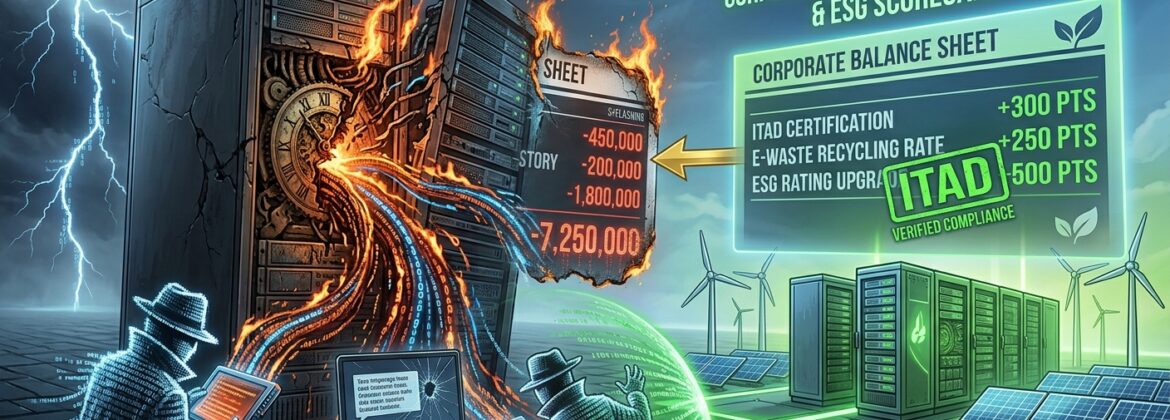
If your company has made net-zero or ESG commitments—and let’s face it, most large enterprises have—then your IT asset disposition strategy just became a board-level priority. Here’s why: scope 3 emissions from e-waste account for significant carbon impact. Investors, regulators, and customers are now measuring whether you’re walking the walk on sustainability.
The ESG Reporting Reality
Environmental, Social, and Governance reporting has moved from “nice to have” to “required.” The CSRD (Corporate Sustainability Reporting Directive) mandates detailed environmental accounting. But here’s where most companies stumble: they’re reporting energy efficiency, renewable energy purchases, and office recycling—while ignoring the massive environmental footprint of their IT equipment lifecycle.
Electronics manufacturing is carbon-intensive. An average server creates roughly 2 metric tons of CO₂ in production. If you’re retiring servers without accounting for their end-of-life environmental impact, your ESG report is telling an incomplete story.
Scope 3 Emissions & ITAD
Most enterprises focus on Scope 1 (direct) and Scope 2 (energy) emissions. But Scope 3—indirect emissions from your value chain—is where e-waste lives. When old IT equipment ends up in a landfill instead of being properly recycled, the environmental cost is significant:
Landfilled electronics release greenhouse gases as materials decompose
Improper recycling prevents material recovery, requiring new resource extraction and manufacturing
Hazardous materials (lead, mercury, cadmium) contaminate soil and water
Transportation emissions from unoptimized logistics chains
Lost opportunity costs for recovered materials and components
Proper ITAD through certified recyclers like CSC actually reduces your Scope 3 footprint. Recovered materials lower manufacturing demand. Energy-efficient refurbishment extends device lifecycles. It’s measurable carbon impact.
Investor Pressure & Stock Price Impact
Here’s something that gets CFO attention: ESG-focused investors now screen companies on ITAD practices. BlackRock, Vanguard, and other asset managers include ITAD transparency in their ESG scoring. Companies with poor ITAD practices see:
Reduced institutional investment allocation
Lower analyst ratings from ESG-focused research firms
Activist investor campaigns on sustainability
Higher cost of capital due to perceived governance risk
Exclusion from ESG-focused investment funds
Conversely, companies with documented, certified ITAD practices gain competitive advantage. It’s a direct link to valuation.
Building Your Net-Zero ITAD Strategy
If you’ve committed to net-zero by 2040 or 2050, your ITAD strategy must support that commitment. This means:
Partner with R2v3-certified recyclers like CSC who report carbon metrics
Track material recovery rates and avoided emissions from reuse
Include ITAD in your Scope 3 inventory and reduction targets
Report ITAD sustainability metrics in your annual ESG disclosure
Extend device lifecycles through refurbishment when possible
Measure and communicate avoided emissions from proper recycling vs. landfill disposal
The math is compelling: a single server lifecycle managed through certified ITAD prevents approximately 0.79 metric tons of CO₂ equivalents compared to landfill disposal. With thousands of devices retired annually, this becomes material to your net-zero trajectory.
The Competitive Advantage
Early movers in ITAD-integrated ESG strategies gain storytelling power. You can communicate concrete environmental impact to stakeholders. Investors see governance excellence. Customers increasingly prefer vendors with proven sustainability practices.
It’s not just compliance anymore—it’s competitive differentiation.

Leave a Comment