
Category: Cybersecurity & Data Protection | Read Time: 11 minutes
Executive Summary
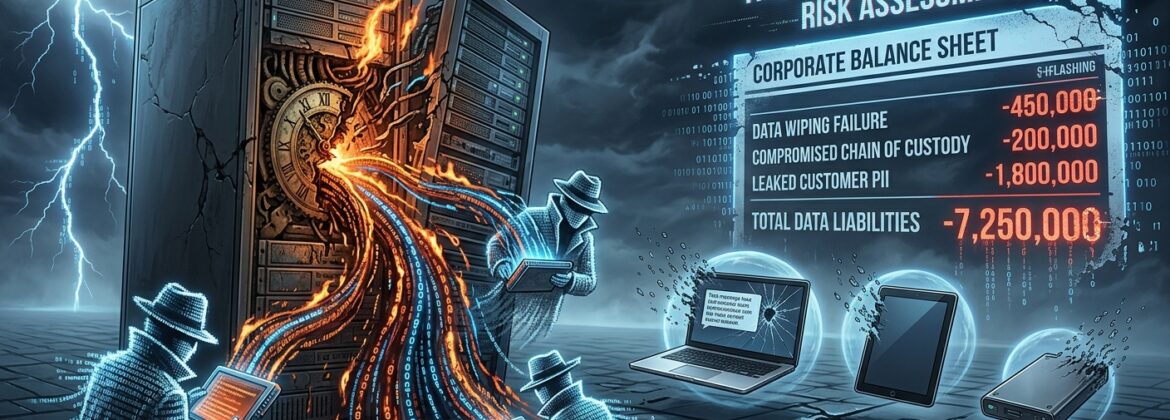
Your IT security team invests heavily in firewalls, intrusion detection, encryption protocols. They’re defending the castle. But here’s what nobody wants to admit: the most vulnerable moment for your company’s data isn’t when it’s in production. It’s when you’re getting rid of it.
Retired IT hardware is a treasure trove for data thieves. Hard drives, SSDs, USB devices, phones, printers—they all retain sensitive information. Customer records. Proprietary source code. Trade secrets. Financial data. All sitting in a warehouse waiting to be recycled.
And here’s the thing: most companies have absolutely no idea how much sensitive data is living on their retired equipment. They definitely don’t have verified proof that it’s been irrecoverably destroyed. That’s not just a security vulnerability—it’s a liability crisis waiting to happen.
The Reality of Data Recovery
Let’s talk about something uncomfortable: data recovery from discarded storage media is trivial for anyone with basic technical skills.
A deleted file isn’t gone. It’s marked as deleted, but the data remains on the drive. Overwriting the free space helps, but not all data gets overwritten. Standard factory resets? They often leave data intact. Simply erasing the partition table? Recoverable in minutes with commodity tools.
The data recovery industry exists for a reason. Companies like DriveSavers, Seagate Recovery, and OnTrack can recover data from damaged, encrypted, or supposedly-wiped drives. If a crime scene investigator can recover data, so can someone with malicious intent.
We’ve seen cases where retired servers ended up in secondary markets—refurbished and resold—with customer data still intact. We’ve seen drives from failed data centers get picked up at auction with transaction records, employee information, and financial data recoverable from unencrypted sectors.
And here’s the part that really matters: if that data breach traces back to your company’s inadequate disposal procedures, you’re liable. Not the recycler, not the person who bought the equipment secondhand—you. Your company’s negligence created the liability.
The NIST 800-88 Standard: What Actually Protects You
The National Institute of Standards and Technology (NIST) published guidelines for data destruction that are now the gold standard for regulated industries. NIST 800-88 requires certified methods of data destruction, with documented proof.
We’re talking about methods like:
Cryptographic Erasure: The drive is encrypted with a master key, then the key is destroyed. The data is theoretically still on the drive, but it’s cryptographically inaccessible. When done properly, this meets NIST standards.
Overwriting: Multiple passes of random data overwrite every sector of the drive. NIST standards typically require 3-7 passes depending on the regulatory environment and data sensitivity.
Physical Destruction: The drive is physically destroyed using certified shredders that reduce it to particles smaller than 2mm. No recovery possible.
The key word here is “certified.” Your company needs documented proof—certificates of destruction, audit logs, chain of custody documentation—showing that each device was destroyed according to NIST standards. That’s not just security theater. That’s your legal defense.
When regulators ask what happened to the sensitive data on your retired equipment, you pull out NIST-certified destruction certificates. When your insurance company evaluates your risk, they see documented compliance. When you’re audited by your industry regulator, you have proof.
Real-World Data Breach Scenarios
Let’s walk through some scenarios we’ve encountered:
Scenario 1: Banking Sector
A mid-sized bank disposed of retired servers through a “recycler” that actually just wiped the partition table and sold the drives to a refurbisher. A tech-savvy buyer recovered customer account information, routing numbers, and transaction history. The breach was traced back to the bank’s inadequate disposal procedures.
Cost to the bank: $8.5M settlement + $2.1M regulatory fine + shareholder derivative lawsuit + stock price decline. The “cheap” recycler saved maybe $15K. The inadequate procedure cost the company $12M+.
Scenario 2: Healthcare
A hospital chain retired medical device servers that still contained patient health records. The devices were improperly handled by a non-certified facility. Patient data was recoverable.
HIPAA violation: $750K OCR fine. Patient notification costs: $1.2M. Mandatory corrective action plan with ongoing monitoring. Brand reputation damage: unquantifiable but serious.
Scenario 3: Software Development
A software company disposed of development servers that contained proprietary source code, architecture diagrams, and unreleased product roadmaps. The drives were purchased second-hand by a competitor’s employee who noticed the valuable content.
Lost competitive advantage. Trade secret theft. Depending on the jurisdiction, potential criminal liability. Settlement costs: $2-10M.
Why Your Recycler’s Security Practices Matter
Not all recyclers are equal when it comes to data security. Some operate in warehouses with minimal security. Some sell drives that haven’t been properly tested for data destruction. Some use outdated wiping techniques that don’t meet current standards.
R2v3-certified recyclers, by contrast, are required to:
• Implement secure chain of custody from collection through destruction
• Use certified data destruction methods (NIST 800-88 compliant)
• Maintain detailed audit logs of every device
• Issue certificates of destruction for each device
• Allow independent auditing of processes
• Maintain secure facilities with limited access
This isn’t just security theater. These requirements exist because the stakes are high. A single data breach from improper disposal can cost millions. Certified recyclers have invested in infrastructure and processes to make that impossible.
The Documentation Advantage
Here’s what separates compliant from non-compliant ITAD: documentation.
When you work with an R2v3-certified recycler, you get:
• Asset inventory tracking (serial numbers, descriptions, data classifications)
• Destruction certificates for each device (method used, date, certifier)
• Chain of custody documentation
• Audit logs showing secure handling throughout the process
• Test results verifying data destruction
When a regulator asks “Can you prove that customer data from your retired servers was irrecoverably destroyed?” you pull out documentation. Not a vague assurance. Not a best-guess. Documented proof.
That documentation is your liability shield. It proves your company exercised due diligence. It demonstrates you took data security seriously. It’s the difference between a costly incident and a successful audit defense.
Building Your Data Security ITAD Strategy
Here’s what your IT and compliance teams should be doing:
1. Classify Your Data: Know what sensitive data is on your retired equipment. Customer data? Proprietary code? Financial records? Each classification requires appropriate destruction methods.
2. Require R2v3 Certification: Make it non-negotiable. Your ITAD partner should be independently audited and certified. Full stop.
3. Verify NIST 800-88 Compliance: Confirm that your recycler uses certified data destruction methods and provides documentation.
4. Archive Documentation: Keep destruction certificates indefinitely. You may need them for audits or litigation years later.
5. Audit Your Recycler: R2v3-certified facilities welcome audits. Conduct them periodically to verify ongoing compliance.
The Bottom Line
Your company’s data doesn’t become a security non-issue just because it’s on a retired server. If anything, it’s more vulnerable. Without proper handling, that old equipment is a liability waiting to explode.
R2v3-certified ITAD with NIST 800-88 data destruction is how you manage that risk. It’s not expensive insurance—it’s essential infrastructure. It’s the difference between sleep and sleepless nights when your security team thinks about end-of-life IT equipment.
Chicago Surplus Computers provides NIST 800-88 certified data destruction with complete documentation. We destroy data so thoroughly that recovery is technically impossible. And we prove it.
Learn more at https://chicagosurpluscomputers.com/itad-calculator/
Follow CSC on LinkedIn: https://www.linkedin.com/company/chicagosurpluscomputers/

Leave a Comment