
A Market Forming in Real Time
Used data center GPUs have moved from a niche into a visible secondary market. Brokers, refurbishers and some operators now trade accelerator cards and complete GPU servers, and reports from the last year describe high demand for older cards in inference, rendering, research and development environments. Some recent coverage has even described operators in one region refurbishing high-memory consumer-class cards for resale because of overcapacity in their own facilities. For an enterprise that is retiring this hardware, the opportunity is real. The challenge is that a GPU is only worth what a buyer can verify. A card with unknown history, unclear thermal damage, or an unclear data-wipe record will be discounted heavily or refused.
What a Serious Buyer Will Ask
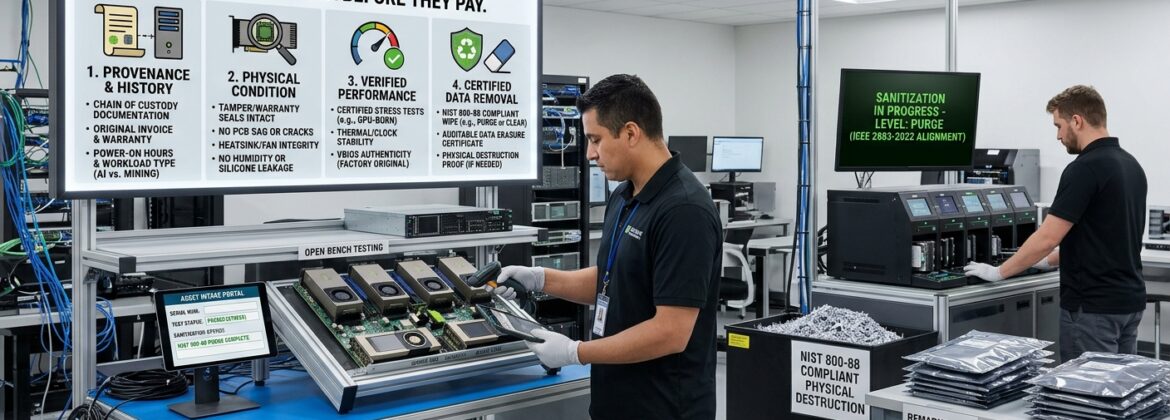
Experienced buyers run a predictable set of checks. Understanding them tells you what documentation to prepare before the first call. They will ask for the exact model, serial number, and firmware version. They will want to know whether the unit ran in a single facility or moved between sites, and whether it was used in a hot or liquid-cooled environment. They will look for signs of thermal stress, such as discoloration on connectors, fan wear, or evidence of repaste. They will check whether memory has been replaced, and whether the card's error counters show correctable or uncorrectable faults during its last operating period. Finally, they will ask how the data was removed. A buyer who plans to reuse the hardware needs to know that no customer data, model weights or proprietary code remains on local storage or in firmware-accessible areas.
Documentation Turns Hardware Into Inventory
A card that arrives with a complete record moves faster and sells for more. The record should include the original purchase date, the workload type, the operating hours if they are logged, the maintenance history, and the decommission date. It should also include the sanitization method used, the tool or procedure, and a device-level certificate that ties the result to the serial number. Organizations that treat this record as part of the asset itself, rather than as paperwork created at the end, find that resale negotiations are shorter and more predictable.
Pricing Without Guesswork
Resale value for accelerators can change quickly when a new generation ships. Price a batch against recent completed sales where you can find them, not against list prices or optimistic brokers' estimates. Build in a range, and decide in advance what happens if the market moves against you. Some organizations choose to hold units for a defined period, others prefer to sell at once. Both can be right. What matters is that the decision is made from a written rule rather than from urgency.
Export and Compliance Considerations
High-performance accelerators can be subject to export controls. Before any cross-border sale, confirm the classification of the hardware, screen the buyer against the relevant restricted-party lists, and document the end use. A disposition provider with export-control procedures protects you from a sale that could create legal exposure long after the unit has left your building.
Where ITAD Providers Add Value
A capable provider does more than haul equipment away. It tests units, grades them, documents condition, performs compliant sanitization, manages the buyer relationship, and handles the paperwork that makes the sale defensible. For an enterprise without an internal resale team, this is often the difference between recovering real value and letting an unverified buyer take most of it.
A Practical Starting Point
If you have accelerators coming off lease or out of production, pull the records for the first batch and check how complete they are. Gaps are common. Closing them before the next batch arrives will improve both your recovery rate and your audit position.
Plan your next retirement with confidence
Estimate the value and compliance scope of your IT assets with our ITAD calculator.
Open the ITAD Calculator
Leave a Comment